Machen Sie sich bereit, indem Sie das Übungsrepository klonen:
git clone https://github.com/Ecohydraulics/Exercise-ManningStrickler.git
Figure 1:Die Rhône in der Schweiz (Quelle: Sebastian Schwindt 2014).
Theoretischer Hintergrund
The Gauckler-Manning-Strickler formula Kundu & Cohen, 2008 (or Strickler formula in Europe) relates water depth and flow velocity of open channel flow based on the assumption of one-dimensional (cross-section-averaged) flow characteristics. The Strickler formula results from a heavy simplification of the Navier-Stokes-Gleichungen and the Kontinuitätsgleichung Kundu & Cohen, 2008. Even though one-dimensional (1d) approaches have largely been replaced by at least two-dimensional (2d) numerical models today, the 1d Strickler formula is still frequently used as a first approximation for boundary conditions.
Die Grundform der Strickler Formel ist:
wobei:
die querschnittsgemittelte Strömungsgeschwindigkeit in (m/s)
is the Strickler coefficient in fictional (m/s) corresponding to the inverse of Manning’s .
20 ( 0.05) for rough, complex, and near-natural rivers
90 ( 0.011) for smooth, concrete-lined channels
26/ (approximation based on the grain size , where 90% of the surface sediment grains are smaller, according to Meyer-Peter & Müller (1948).
ist die hypothetische Energiesteigung (m/m), von der angenommen werden kann, dass sie der Kanalsteigung für stetige, gleichmäßige Strömungsverhältnisse entspricht.
ist der hydraulische Radius in (m)
The hydraulic radius is the ratio of wetted area and wetted perimeter . Both and can be calculated as a function of the water depth and the channel base width . Many channel cross-sections can be approximated with a trapezoidal shape, where the water surface width (with being the bank slope as indicated in the figure below).
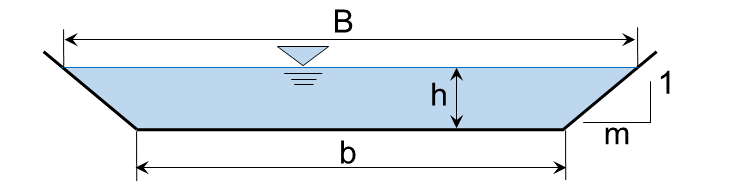
Daher ergeben sich und aus den folgenden Formeln:
Finally, the discharge (m³/s) can be calculated as:
Berechnung der Entlastung
Write a script that prints the discharge as a function of the channel base width , bank slope , water depth , the slope , and the Strickler coefficient .
Funktionalisieren
Cast the calculation into a function (e.g., def calc_discharge(b, h, k_st, m, S): ...) that returns the discharge .
Flexibilisierung
Machen Sie die Funktion durch die Implementierung von (optional) keyword arguments flexibler, so dass ein Benutzer wahlweise entweder (D90), den Strickler-Koeffizienten (k_st) oder Mannings (n_m) bereitstellen kann.
Invertieren der Funktion
Die Rückwärtslösung der Manning-Strickler Formel ist ein nichtlineares Problem, wenn der Kanal nicht rechteckig ist. Aus diesem Grund ist eine iterative Approximation erforderlich und hier verwenden wir das Newton-Raphson-Schema Akanbi & Katopodes, 1987 für diesen Zweck (siehe auch die die ILIAS-Plattform der Universität Stuttgart].
Use a Newton-Raphson solution scheme Paine, 1992 to interpolate the water depth h for a given discharge Q of a trapezoidal channel.
Schreibe eine neue Funktion
def interpolate_h(Q, b, m, S, **kwargs):Define an initial guess of
h(e.g.,h = 1.0) and an initial error margin (e.g.,eps = 1.0)Use a
whileloop until the error margin is negligible small (e.g.,while eps > 10**-3:) and calculate the :wetted area
A(see above formula)wetted perimeter
P(see above formula)aktuelle Entladungsschätzung (basierend auf
h):Qk = A ** (5/3) * sqrt(S) / (n_m * P ** (2 / 3))Fehlermeldung
eps = abs(Q - Qk) / Qderivative of
A:dA_dh = b + 2 * m * hderivative of
P:dP_dh = 2 * m.sqrt(m ** 2 + 1)function that should become zero
F = n_m * Q * P ** (2 / 3) - A ** (5 / 3) * m.sqrt(S)its derivative:
dF_dh = 2/3 * n_m * Q * P ** (-1 / 3) * dP_dh - 5 / 3 * A ** (2 / 3) * m.sqrt(S) * dA_dhwater depth update
h = abs(h - F / dF_dh)
Implementieren Sie einen Notstopp, um endlose Iterationen zu vermeiden - das Newton-Raphson-Schema ist nicht immer stabil!
Return
hundeps(oder berechnete EntladungQk)
- Kundu, P. K., & Cohen, I. M. (2008). Fluid Mechanics (4th ed.). Elsevier Inc.
- Meyer-Peter, E., & Müller, R. (1948). Formulas for Bed-Load transport. IAHSR, Appendix 2, 2nd meeting, 39–65. http://resolver.tudelft.nl/uuid:4fda9b61-be28-4703-ab06-43cdc2a21bd7
- Akanbi, A. A., & Katopodes, N. D. (1987). Model for flood propagation on initially dry land. Journal of Hydraulic Engineering, 114(7), 689–706. 10.1061/(ASCE)0733-9429(1988)114:7(689)
- Paine, J. N. (1992). Open-Channel Flow Algorithm in Newton-Raphson Form. Journal of Irrigation and Drainage Engineering, 118(2), 306–319.