Principles
The calculation of bedload transport requires expert knowledge about the modeled ecosystem for judging whether the system is sediment supply-limited or transport capacity-limited Church & Ferguson, 2015.
- Sediment supply-limited rivers
- A sediment supply-limited river is characterized by clearly visible incision trends indicating that the flow could potentially transport more sediment than is available in the river. Sediment-supply limited river sections typically occur downstream of dams, which represent an insurmountable barrier for sediment. Thus, in a supply-limited river, the flow competence (hydrodynamic force or transport capacity) is insufficient to mobilize a typically coarse riverbed, but it is sufficient for transporting external sediment supply.
- Transport capacity-limited (alluvial) rivers
- A transport capacity-limited river is characterized by sediment abundance where the flow is too small to transport all available sediment during a flood. Sediment accumulations (i.e., the alluvium) are present and the channel tends to braid into anabranches (or to anastomose in fine/sand-dominated environments). Thus, the flow competence (or transport capacity) is insufficient to transport the entire amount of available sediment (external supply and riverbed).
The following figures illustrate sediment supply-limited river reaches and a transport capacity-limited river reach.
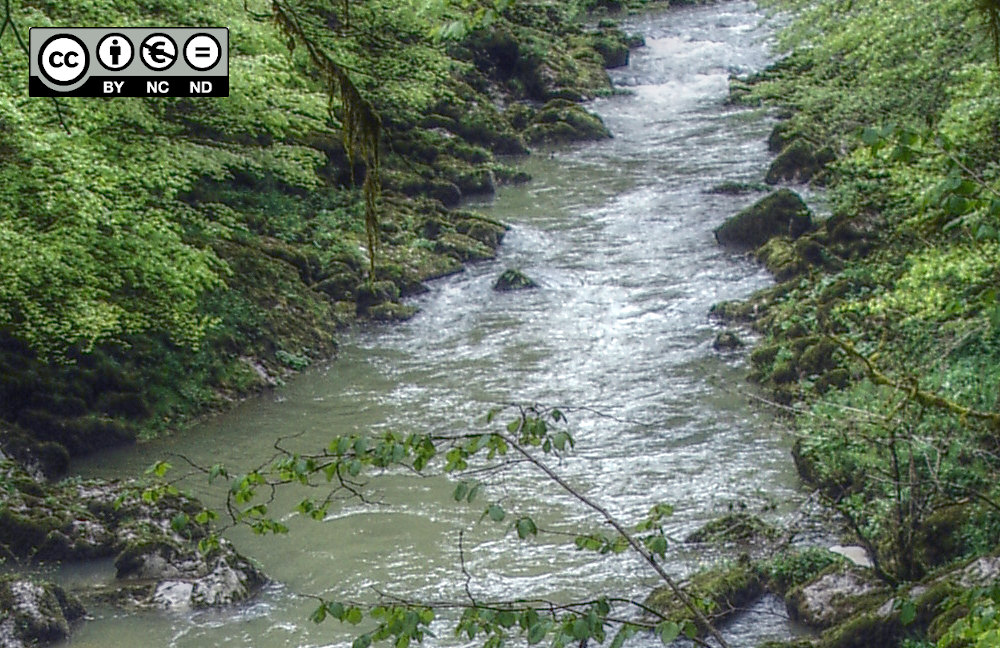
Figure 1:The Doubs in the Franche-Comté (France) during a small flood. The sediment supply is interrupted by a cascade of dams upstream with the consequence of a straight monotonous channel with significant plant growth along the banks. The riverbed primarily consists of boulders that are immobile most of the time. Thus, the river section can be characterized as artificially sediment supply-limited (picture: Sebastian Schwindt 2015).
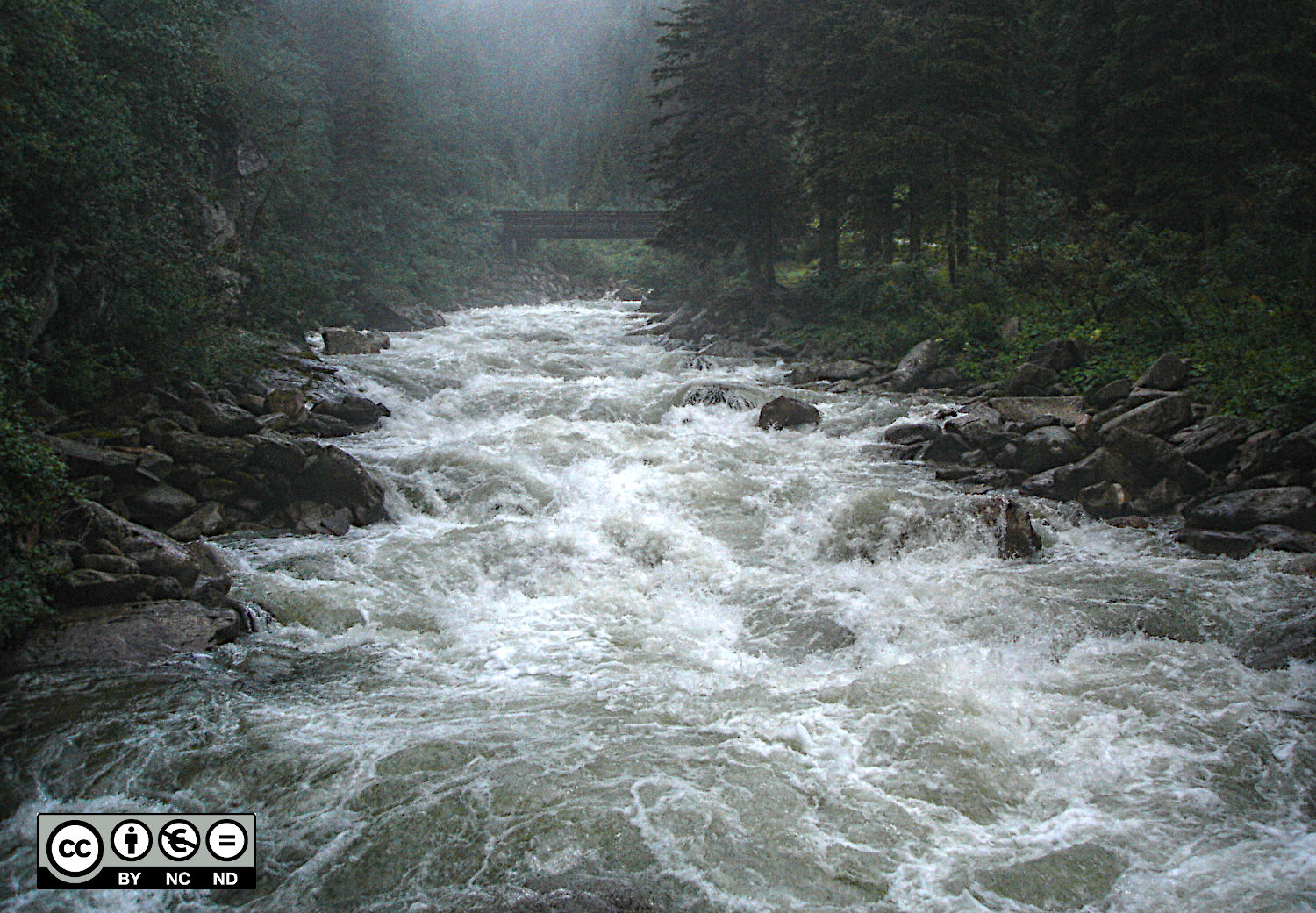
Figure 2:The Krimmler Ache in Austria during a small flood event. Even though the watershed has a high Sediment yield, the transport capacity of the water in this river section is so high that the riverbed predominantly consists of large boulders. Thus, the river section can be characterized as naturally sediment supply-limited (picture: Sebastian Schwindt 2010).
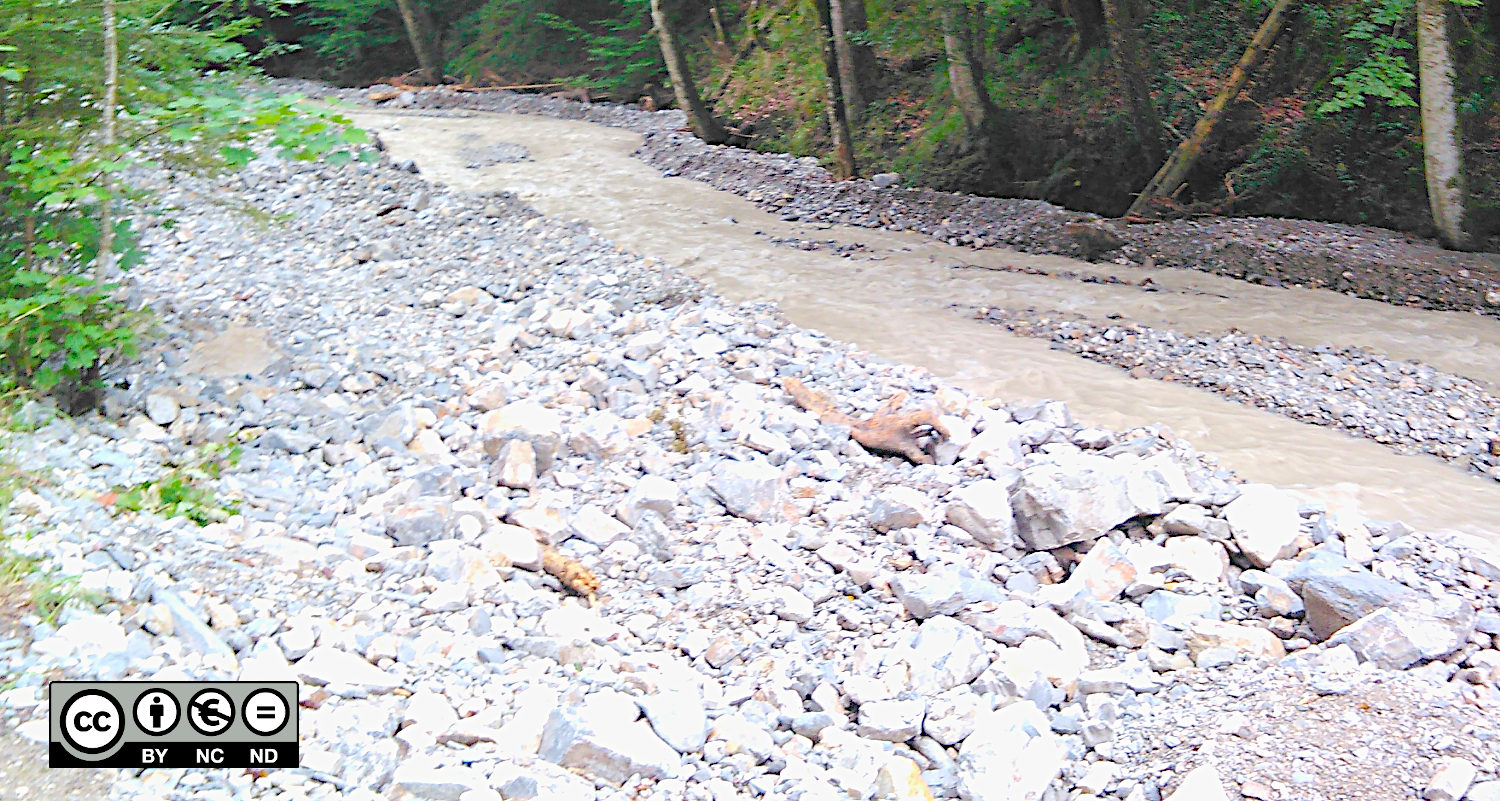
Figure 3:The Jenbach in the Bavarian Alps (Germany) after an intense natural sediment supply in an upstream reach in the form of a landslide. The river section can be characterized as transport capacity-limited (picture: Sebastian Schwindt 2020).
Why is the differentiation between sediment supply and transport capacity-limited rivers important for numerical modeling?
Gaia provides different formulae for calculating bedload transport, which are partially either derived from lab experiments with infinite sediment supply (e.g., the Meyer-Peter & Müller (1948) formula and its derivates, see below) or from field measurements in partially transport capacity-limited rivers (e.g., Wilcock (1993)). Formulae that account for limited sediment supply often involve a correction factor for the Shields parameter.
Formulae and Parameters
Bedload is typically designated with (in kgsm i.e. weight per unit time and width) and accounts for particulate transport in the form of the displacement of rolling, sliding, and/or jumping coarse particles. In river hydraulics, the so-called Dimensionless bed shear stress, also referred to as Shields parameter Shields, 1936, is often used as a threshold value for the mobilization of sediment from the riverbed. TELEMAC and Gaia build on a dimensionless expression of bedload transport intensity according to Einstein (1950):
where is the density of sediment grains; is the ratio of sediment grain and water density (typically 2.68) Schwindt, 2017; is gravitational acceleration; and is the characteristic grain diameter of the sediment class (cf. Sediment Classes). Note that the dimensionless expression and the dimensional expression represent unit bedload (i.e., bedload normalized by a unit of width). Gaia outputs are dimensional and correspond to (recall the VARIABLES FOR GRAPHIC PRINTOUTS definitions in the General Parameters section) where the unit of width corresponds to the edge length of a numerical mesh cell over which the mass fluxes are calculated.
Comment on the Original Einstein (1950) Expression
The original equation for can be found on page 34 (Equation 42) in Einstein (1950). This formula involves an additional division by the gravitational acceleration , which does not appear in later references to the Einstein expression of and would also not result in a dimensionless term. For this reason, Equation (1) is adapted here.
Equation (1) expresses only the dimensional conversion for bedload transport (i.e., the way how dimensions are removed or added to sediment transport). In fact, this is only the first step to solve the other side of a bedload equation using a (semi-) empirical formula. To calculate , Gaia provides a set of (semi-) empirical formulae, which can be modified with user Fortran files and defined in the Gaia steering file with the BED-LOAD TRANSPORT FORMULA FOR ALL SANDS integer keyword. Table 1 lists possible integers for the keyword to define a bedload transport formulae, including references to original publications, formula application ranges, and the names of the Fortran source files for modifications.
Table 1:Bedload transport formulae implemented in Gaia with application limits regarding the grain diameter , cross section-averaged Froude number , slope , water depth , and flow velocity . The Fortran files live in the /telemac/sources/gaia/ directory.
| Gaia | Author(s) | Fr; ; ; and | User Fortran | |
|---|---|---|---|---|
| (no.) | (ref.) | (10m) | (-); (-); (m); (m/s) | (file name) |
1 | Meyer-Peter & Müller (1948) | 0.4 28.6 | 10639 0.00040.02 0.011.2 0.2 | bedload_meyer.f |
2 | Einstein (1950)-Brown (1949) | 0.2532 | bedload_einst.f | |
3 | Engelund & Hansen (1967) + Chollet & Cunge (1979) | 0.155.0 | 0.110 | bedload_engel_cc.f |
7 | Van Rijn (1984) | 0.62.0 | 0.5 0.2 | bedload_vanrijn.f |
10 | Wilcock & Crowe (2003) | 0.063 | bedload_wilcock_crowe.f | |
30 | Engelund & Hansen (1967) | 0.155.0 | 0.110 | bedload_engel.f |
Note that the Engelund-Hansen formulae (options 3 and 30) compute total sediment transport, that is, the sum of bedload and suspended load. So when using these formulae, do not additionally activate suspended load modeling to avoid double-counting.
To use the Meyer-Peter & Müller (1948) formula (1 according to Tab. 1) in this tutorial, add the following line to the gaia-morphdynamics.cas steering file:
/ continued: gaia-morphodynamics.cas
/
/ BEDLOAD
/
BED LOAD FOR ALL SANDS : YES / deactivate with NO
BED-LOAD TRANSPORT FORMULA FOR ALL SANDS : 1
The following sections provide more details on how is calculated with the pre-defined formulae listed in Tab. 1.
User Fortran Files
To implement a user Fortran file, copy the original TELEMAC Fortran file from the /telemac/sources/ directory (e.g., /telemac/sources/gaia/bedload_einst.f) to the project directory (e.g., /telemac/simulations/gaia-tutorial/user_fortran/bedload_einst.f). Finally, tell TELEMAC where to look for user fortran files by defining the following keyword in a steering file (e.g., in gaia-morphodynamics.cas):
FORTRAN FILE : 'user_fortran'
Meyer-Peter and Müller (1948)
The Meyer-Peter & Müller (1948) formula was published in 1948 by Swiss researchers Eugen Meyer-Peter, professor at ETH Zurich and founder of the school’s hydraulics laboratory (Zurich’s famous VAW), and Robert Müller. Their empirical formula is the result of more than a decade of collaboration and the elaboration began one year after the VAW was founded in 1931 when Robert Müller was appointed assistant to Eugen Meyer-Peter. The two scientists also worked with Henry Favre and Hans-Albert Einstein who came up with another approach for calculating bedload. An early version of the Meyer-Peter & Müller (1948) formula was published in 1934 and it is the basis for many other formulas that refer to a critical Dimensionless bed shear stress (i.e., Shields parameter). It is important to remember that the formula is based on data from lab flume experiments with high sediment supply. This is why bedload transport calculated with the Meyer-Peter & Müller (1948) formula corresponds to the hydraulic transport capacity of an alluvial channel. Thus, the Meyer-Peter & Müller (1948) formula tends to overestimate bedload transport and it is inherently designed for estimating bedload based on simplified 1d cross section-averaged hydraulics (see also the Python sediment transport exercise). Good results can be expected when flood flows are simulated in an alluvial river section.
Ultimately, the left side of Equation (1) () can be calculated with the Meyer-Peter & Müller (1948) formula as follows:
where is the MPM coefficient (default is 8), denotes the Shields parameter ( 0.047 and up to 0.07 in mountain rivers), and is the Dimensionless bed shear stress. When using the Meyer-Peter & Müller (1948) formula with Gaia, consistency with original publications is ensured by defining and in the steering file:
/ continued: gaia-morphodynamics.cas
/
/ BEDLOAD
BED-LOAD TRANSPORT FORMULA FOR ALL SANDS : 1 / see above
CLASSES SHIELDS PARAMETERS : 0.047;0.047;0.047
MPM COEFFICIENT : 8To directly continue with the tutorial using the Meyer-Peter & Müller (1948) formula, jump to the correction factors section.
Einstein-Brown (1942/49)
Hans Albert Einstein, son of the famous Albert Einstein, was a pioneer of probability-based analyses of sediment transport. In particular, he hypothesized that the beginning and the end of sediment motion can be expressed in terms of probabilities. Furthermore, Einstein assumed that sediment motion is a series of step-wise displacements followed by rest periods and that the average distance of a particle displacement is approximately a hundred times the particle (grain) diameter. Moreover, to account for observations he made in lab flume experiments, Einstein introduced hiding and lifting correction coefficients Einstein, 1942.
The Einstein formula differs from any Meyer-Peter & Müller (1948)-based formula in that it does not imply a threshold for incipient motion of sediment. However, despite or because Einstein’s sediment transport theory is more complex than many other bedload transport formulae, it did not become very popular in engineering applications. Today, Gaia enables the user-friendly application of Einstein’s formula, which was similarly presented by Brown (1949) at an engineering hydraulic conference in 1949. According to Einstein (1942)-Brown (1949), the left side of Equation (1) () is calculated as follows:
where
is the dimensionless particle diameter calculated as:
where is the ratio of sediment grain and water density (typically 2.68); is gravitational acceleration; and is the kinematic viscosity of water (10m s) Schwindt, 2017.
To use the Einstein (1942)-Brown (1949) formulae in Gaia use:
BED-LOAD TRANSPORT FORMULA FOR ALL SANDS : 2Engelund-Hansen (1967) / Chollet-Cunge
The Engelund & Hansen (1967) formula accounts for total sediment transport including Bedload and Suspended load. Starting from the Bagnold power-approach Bagnold, 1966Bagnold, 1980, the Engelund & Hansen (1967) formula was developed for sediment transport calculations over dune channel beds. The approach accounts for energy losses required to drive particles uphill on dunes of the riverbed. The Bagnold (1966) theory considers the total shear as the sum of the shear transmitted between grains and the fluid, and the shear transmitted by momentum changes caused by intergranular collisions. Thus, erosion takes place as long as the Dimensionless bed shear stress is greater or equal to its critical value (i.e., the Shields parameter). Gaia implements the Engelund & Hansen (1967) by calculating the left side of Equation (1) () as follows:
where is an adimensional friction coefficient and is the Shields number without the skin friction correction factor. Read more about skin friction in the correction factors section. To use the original Engelund & Hansen (1967) formula in Gaia use:
BED-LOAD TRANSPORT FORMULA FOR ALL SANDS : 30In addition, Chollet & Cunge (1979) introduced a step-wise function for the calculation of a modified Shields parameter that accounts for different transport regimes:
To apply the Chollet & Cunge (1979) modification of the Engelund & Hansen (1967) formula use:
BED-LOAD TRANSPORT FORMULA FOR ALL SANDS : 3van Rijn (1984)
The sediment transport formula from Leo van Rijn Van Rijn, 1984 is inspired by the theories from Bagnold (1980), Einstein (1942), and Ackers & White (1973). The Van Rijn (1984) formulae assume that bedload is dominated by gravity while suspended load transport is controlled by turbulence according to Bagnold (1980). To this end, the Van Rijn (1984) formulae calculate bedload transport similar to Ackers & White (1973) where transport rates depend on friction velocities. To calibrate his near-bed (bedload) solid transport model, Van Rijn (1984) used data from experiments on flat-bed (zero-slope) channels with an average sediment grain diameter of 1.8 mm. Van Rijn (1984) conducted additional experiments to vet the results of his model against varying grain diameters between 0.2 and 2 mm. In addition, Van Rijn (1984) established criteria for sediment suspension based on laboratory experiments with grain diameters of less than 0.5 mm and by simplifying calibration parameters empirically. While the original Van Rijn (1984) formula accounts for total sediment transport (i.e., Bedload and Suspended load), the following explanations for the implementation in Gaia are limited to Bedload only.
According to Van Rijn (1984), the left side of Equation (1) () is calculated as follows:
Explanations of the Dimensionless bed shear stress , its critical value (i.e., the Shields parameter), and the dimensionless grain diameter are provided in the above sections on the Meyer-Peter and Müller and the Einstein-Brown formulae.
To use the Van Rijn (1984) formula in Gaia use:
BED-LOAD TRANSPORT FORMULA FOR ALL SANDS : 7Wilcock-Crowe (2003)
The Wilcock & Crowe (2003) approach is a multi-fraction sediment transport model that is primarily applicable in armored river sections for modeling bed aggradation or degradation. The model is based on surface investigations and is particularly adapted for predicting transient conditions of bed armoring. It considers the full size distribution of the bed surface (from finest sands to coarsest gravels) and was calibrated using a total of 49 flume experiments with small-to-high water discharges and five different sediment mixtures.
The approach takes up the idea of Parker (1990) on applying a reference shear stress at which little but constant solid transport rate can be observed. The reference shear stress is close to, but a little bit larger than the Shields parameter . To this end, Wilcock & Crowe (2003) implement a reference transport rate of 0.002 as proposed by Parker (1990).
Moreover, the multi-fraction Wilcock & Crowe (2003) model uses the complete sediment grain size distribution of the riverbed surface and calculates bedload transport for each of the specified grain size classes. The sediment transport model builds on flume experiments from Proffitt & Sutherland (1983) and Parker (1990), and it accounts for hiding/exposure effects on gravel transport as a function of the sand fraction in the riverbed. The hiding-exposure function is designed to resolve discrepancies observed from previous experiments, including the hiding-exposure effect of sand content on gravel transport for weak to high values of sand content in the bulk.
In a nutshell, the Wilcock & Crowe (2003) model represents a further development of the Meyer-Peter & Müller (1948) formula, takes up the implementation of a reference transport rate Parker, 1990, and it is calibrated to hiding/exposure effects as a function of the sand fraction.
To use the Wilcock & Crowe (2003) formula in Gaia, define multiple sediment classes and use:
BED-LOAD TRANSPORT FORMULA FOR ALL SANDS : 10Correction Factors
Correction factors for sediment transport may be needed to account for transversal channel slope, secondary currents, or skin friction correction.
Friction Correctors
Friction is often considered with simplified approaches lumping together skin friction and form drag, but in a two-dimensional model, only skin friction affects bedload. Einstein (1950) accounts for skin friction with a correction factor for (dimensional) bed shear stress :
The correction factor is defined as the ratio of the skin friction-only coefficient and the global friction coefficient (i.e., lumped skin friction and form drag):
The skin friction-only coefficient is calculated as:
where is the Von Karmàn (1930) constant (0.4), is water depth, and is the representative roughness length calculated as , where is a calibration parameter (read more in the section on bedload calibration).
Gaia uses by default the skin friction correction coefficient that it derives from the hydrodynamic solver (i.e., Telemac2d/3d). In very shallow waters, this behavior might cause instabilities. Therefore, the SKIN FRICTION CORRECTION keyword can be set in Gaia to control the correction factor calculation:
0: disables correction, setting (total bed shear stress from hydrodynamics is used directly)1: enables skin friction correction (default), computing according to Equations (10) and (11)2: enables a bedform predictor that accounts for ripples when computing
To disable skin friction correction (i.e., set to 1), add the following to the Gaia steering file (not used in this tutorial):
SKIN FRICTION CORRECTION : 0 / default is 1 to enable skin friction correctionThe coefficient (ratio between skin friction roughness and mean diameter) can be modified with the RATIO BETWEEN SKIN FRICTION AND MEAN DIAMETER keyword (default is 3.0). Read more in section 3.1.8 of the Gaia manual.
The finer the sediment of the riverbed, the more important turbulence created by the bed shape becomes. For instance, skin friction calculated based on a multiple of the diameter of a sand grain’s characteristic roughness length is very small. However, sand tends to shape the riverbed into ripple or dune forms, which cause additional bedform turbulence, as featured in the video below.
by Sebastian Schwindt@ Hydro-Morphodynamics channel on YouTube.
By default, Gaia does not account for turbulence (i.e., roughness effects) of bedforms, but it can be enabled by setting the COMPUTE BED ROUGHNESS AT SEDIMENT SCALE keyword to YES (default is NO). Then, one of the following options for the BED ROUGHNESS PREDICTOR OPTION keyword can be defined:
1for a flat bed assumption using the default approach of (modified with RATIO BETWEEN SKIN FRICTION AND MEAN DIAMETER).2for ripple bedforms. For currents only, the ripple roughness is a function of the mobility number. For waves and combined waves-currents, bedform dimensions are calculated as a function of wave parameters following Wiberg & Harris (1994).3for Van Rijn (2007) total bed roughness predictor (currents only). The total roughness is decomposed into grain roughness, small-scale ripple roughness, mega-ripple component, and dune roughness.
The Gaia manual (section 3.1.9) summarizes the set of equations that go into the calculation of the BED ROUGHNESS PREDICTOR OPTION.
Direction and Magnitude (Intensity)
Natural rivers are characterized by non-straight lines of the Thalweg, which involves that water and sediment are subjected to curve effects. However, water and sediment behave differently in a curve because sediment has greater inertia than water Mosselman & Le, 2016. Gaia accounts for the inertia of sediment transport as a function of water depth, curve radius, a spiral flow coefficient (A), and the depth-averaged, 2d velocities U and V. In addition, sediment transport reacts more inert to horizontal (transversal) channel slope and can be considered in and directions (see also the explanation of the Exner equation). To this end, Gaia calculates the slope-corrected unit bedload transport as follows:
where is the angle between the longitudinal channel () axis and the bedload transport vector (see also the Exner equation), is an empiric bedload intensity correction factor from Koch & Flokstra (1980), and is the riverbed elevation.
The degree of bedload deviation (through ) and the factor can be defined in Gaia with the FORMULA FOR DEVIATION and FORMULA FOR SLOPE EFFECT (horizontal) keywords. To use one or both keywords, the SLOPE EFFECT keyword must be set to YES (default is YES).
The FORMULA FOR DEVIATION keyword can take the following integer values to define a particular formula for the sediment shape function (cf. section 3.1.4 in Gaia manual):
1for bed level computation according to Koch & Flokstra (1980) (default).2for the Talmon et al. (1995) approach based on laboratory experiments, which should be used with the PARAMETER FOR DEVIATION keyword for setting theBETA2parameter (its default isPARAMETER FOR DEVIATION : 0.85, but an optimum was found with1.6Mendoza et al., 2017).3for the Apsley & Stansby (2008) approach based on the critical Shields parameter and the friction angle of the sediment, which should be used with the FRICTION ANGLE OF THE SEDIMENT keyword (default is40.).
The FORMULA FOR SLOPE EFFECT keyword affects not only the direction of sediment transport but also the bedload magnitude (or intensity) and it can take the following values:
1for bed level computation according to Koch & Flokstra (1980) (default and similar to FORMULA FOR DEVIATION). The1-setting enables the definition of the empiric bed slope correction factor in Equation (12) through the BETA keyword (default isBETA : 1.3).To increase bed elevation change, increase BETA.
To decrease bed elevation change, decrease BETA.
2for slope correction in sand-bed rivers based on an approach from Soulsby (1997), which applies a correction of the Shields parameter as a function of the friction angle of the sediment and the riverbed slope. The friction angle can be defined with the additional FRICTION ANGLE OF THE SEDIMENT keyword (default is40.).3for the Apsley & Stansby (2008) approach, which modifies both the critical Shields parameter and the effective dimensionless shear stress. Use with the FRICTION ANGLE OF THE SEDIMENT keyword.
Secondary Currents
Secondary currents may occur in curved channels (i.e., in most near-census natural rivers) where water moves like a gyroscope through river bends. More specifically, secondary flows are helical motions in which water near the surface is driven toward the outer bend, while water near the riverbed is driven toward the inner bend. Thus, secondary flows are a 3d phenomenon that can be represented in 2d models only with auxiliary approaches. For Bedload transport, the near-bed current toward the inner bend is especially important, because it promotes erosion at the outer bend and may lead to deposition at the inner bend.
By default, Telemac2d and Gaia do not consider secondary currents, but an approach based on Engelund (1974) can be enabled by setting the SECONDARY CURRENTS keyword to YES (default is NO). In Gaia, the spiral flow coefficient is set to 7 (Engelund’s value). The SECONDARY CURRENTS ALPHA COEFFICIENT keyword can be used to modify this coefficient as a function of channel bottom roughness:
SECONDARY CURRENTS ALPHA COEFFICIENT : 0.75for a very rough riverbedSECONDARY CURRENTS ALPHA COEFFICIENT : 1.0for a smooth riverbed (default)
For this tutorial use:
/ continued: gaia-morphodynamics.cas
/ ...
SECONDARY CURRENTS : YES
SECONDARY CURRENTS ALPHA COEFFICIENT : 0.8
Boundary Conditions
The Gaia Basis section on boundary conditions explains the geometric definition of open liquid boundaries in the *.cli files. To prescribe a bedload transport of 10 kgs (total solid discharge without pores) across the upstream (LIEBOR=5) boundary and free outflow at the downstream (LIEBOR=4) boundary, add the PRESCRIBED SOLID DISCHARGES keyword to the Gaia steering file (gaia-morphodynamics.cas):
/ continued: gaia-morphodynamics.cas
/ ...
PRESCRIBED SOLID DISCHARGES : 10.;0.
Recall that the first and second values in the list of prescribed solid discharges refer to the first and second open boundary listed in the boundaries-gaia.cli, respectively (i.e., upstream and downstream in that order).
Gaia can be run with liquid boundary files for assigning time-dependent solid discharges (the outflow should be kept in equilibrium). Solid discharge time series can be implemented using 455-5 boundary definitions, analogous to the descriptions of the Telemac2d unsteady boundary setup. For more guidance, have a look at the yen-2d example (telemac/examples/gaia/yen-2d) featuring a quasi-steady bedload simulation at the Rhine River. In addition, more background information about the definition of bedload boundary conditions can be found in sections 3.1.10-3.1.12 in the Gaia manual.
Example Applications
Examples for the implementation of bedload come along with the TELEMAC installation (in the /telemac/examples/gaia/ directory). The following examples in the gaia/ folder feature (pure) bedload calculations:
Application of the Wilcock-Crowe formula (multiple sediment classes): wilcock_crowe-t2d/
Bedload in a bend of the Rhine River with quasi steady (unsteady) flow conditions: yen-2d/
Bedload coupled with Telemac3d: bosse-t3d/
Model of an armored (stratified) riverbed: guenter-t2d/
Coastal sand (bedload) transport coupled with the wave propagation module Tomawac: littoral-t2d-tom/
Coupling with the dredging module Nestor: nestor_dig_test-t2d/
Finite Volume solver featuring time-dependent solid discharge in a
*.liq: flume_bc-t2d/
- Church, M., & Ferguson, R. I. (2015). Morphodynamics: Rivers beyond steady state. Water Resources Research, 51, 1883–1897. 10.1002/2014WR016862
- Meyer-Peter, E., & Müller, R. (1948). Formulas for Bed-Load transport. IAHSR, Appendix 2, 2nd meeting, 39–65. http://resolver.tudelft.nl/uuid:4fda9b61-be28-4703-ab06-43cdc2a21bd7
- Wilcock, P. (1993). Critical shear stress of natural sediments. Journal of Hydraulic Engineering, 119, 491–505.
- Shields, A. (1936). Anwendung der Ähnlichkeitsmechanik und der Turbulenzforschung auf die Geschiebebewegung [Application of the similarity in mechanics and turbulence research on the mobility of bed load] (Vol. 26). Preußische Versuchsanstalt für Wasserbau und Schiffbau. http://resolver.tudelft.nl/uuid:61a19716-a994-4942-9906-f680eb9952d6
- Einstein, H. A. (1950). The Bed-Load Function for Sediment Transport in Open Channel Flows. Technical Bulletin of the USDA Soil Conservation Service, 1026, 71. 10.22004/ag.econ.156389
- Schwindt, S. (2017). Hydro-morphological processes through permeable sediment traps [Thesis No. 7655, Laboratory of Hydraulic Constructions (LCH), Ecole Polytechnique fédérale de Lausanne (EPFL)]. 10.5075/epfl-thesis-7655
- Brown, C. B. (1949). Sediment Transport. In H. Rouse (Ed.), Engineering hydraulics: proceedings of the fourth Hydraulics conference, June 12-15, 1949. John Wiley. https://www.worldcat.org/title/engineering-hydraulics-proceedings-of-the-fourth-hydraulics-conference-iowa-institute-of-hydraulic-research-june-12-15-1949/oclc/802562429
- Engelund, F., & Hansen, E. (1967). A monograph on sediment transport in alluvial streams. TEKNISKFORLAG Skelbrekgade 4 Copenhagen V, Denmark.
- Chollet, J. P., & Cunge, J. A. (1979). New Interpretation of Some Head Loss-Flow Velocity Relationships for Deformable Movable Beds. Journal of Hydraulic Research, 17(1), 1–13. 10.1080/00221687909499596
- Van Rijn, L. C. (1984). Sediment Transport, Part I: Bed Load Transport. Journal of Hydraulic Engineering, 110(10), 1431–1456. 10.1061/(ASCE)0733-9429(1984)110:10(1431)
- Wilcock, P. R., & Crowe, J. C. (2003). Surface-based Transport Model for Mixed-Size Sediment. Journal of Hydraulic Engineering, 129(2), 120–128. 10.1061/(ASCE)0733-9429(2003)129:2(120)
- Wong, M., & Parker, G. (2006). Reanalysis and Correction of Bed-Load Relation of Meyer-Peter and Müller Using Their Own Database. Journal of Hydraulic Engineering, 132(11), 1159–1168. 10.1061/(ASCE)0733-9429(2006)132:11(1159)
- Einstein, H. A. (1942). Formulas for the Transportation of Bed Load. Transactions of the American Society of Civil Engineers, 107(1), 561–577.
- Bagnold, R. A. (1966). An Approach to the Sediment Transport Problem from General Physics. In Geological Survey Professional Paper 422-I. U.S. Government.
- Bagnold, R. A. (1980). An empirical correlation of bedload transport rates in flume and natural rivers. Proceedings of the Royal Society of London, A(372), 453–473. 10.1098/rspa.1980.0122